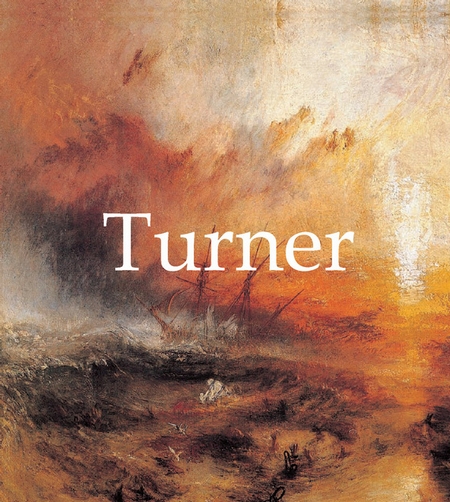
At fifteen, Turner was already exhibiting View of Lambeth. He soon acquired the reputation of an immensely clever watercolourist. A disciple of Girtin and Cozens, he showed in his choice and presentation of theme a picturesque imagination which seemed to mark him out for a brilliant career as an illustrator. He travelled, first in his native land and then on several occasions in France, the Rhine Valley, Switzerland and Italy. He soon began to look beyond illustration. However, even in works in...
At fifteen, Turner was already exhibiting View of Lambeth. He soon acquired the reputation of an immensely clever watercolourist. A disciple of Girtin and Cozens, he showed in his choice and presentation of theme a picturesque imagination which seemed to mark him out for a brilliant career as an illustrator. He travelled, first in his native land and then on several occasions in France, the Rhine Valley, Switzerland and Italy. He soon began to look beyond illustration. However, even in works in which we are tempted to see only picturesque imagination, there appears his dominant and guiding ideal of lyric landscape. His choice of a single master from the past is an eloquent witness for he studied profoundly such canvases of Claude as he could find in England, copying and imitating them with a marvellous degree of perfection. His cult for the great painter never failed. He desired his Sun Rising through Vapour and Dido Building Carthage to be placed in the National Gallery side by side with two of Claude’s masterpieces. And, there, we may still see them and judge how legitimate was this proud and splendid homage. It was only in 1819 that Turner went to Italy, to go again in 1829 and 1840. Certainly Turner experienced emotions and found subjects for reverie which he later translated in terms of his own genius into symphonies of light and colour. Ardour is tempered with melancholy, as shadow strives with light. Melancholy, even as it appears in the enigmatic and profound creation of Albrecht Drer, finds no home in Turner’s protean fairyland – what place could it have in a cosmic dream? Humanity does not appear there, except perhaps as stage characters at whom we hardly glance. Turner’s pictures fascinate us and yet we think of nothing precise, nothing human, only unforgettable colours and phantoms that lay hold on our imaginations. Humanity really only inspires him when linked with the idea of death – a strange death, more a lyrical dissolution – like the finale of an opera.
"Великие вымирания" – книга, меняющая представление об истории Земли. Вместо отвлеченных фактов она знакомит с более чем 20 биологическими видами, чье влияние на планету оказалось ключевым: от косаток и неандертальцев до кораллов и трилобитов. Главная особенность "Великих вымираний" – это уникальный нарративный прием. Вместо сухого изложения фактов, повествование ведется от первого лица какого-то...
Маша Рольникайте вела дневник в 1941—45 годах, с начала оккупации Литвы германскими войсками и до своего освобождения 10 марта 1945 года. Сначала в гетто Вильнюса, затем — в трудовых концентрационных лагерях Штрасденгоф (Рига, Латвия) и Штуттгоф (Польша). Дневник её менее известен, но не менее значим, чем дневник Анны Франк. Часть дневников Маше удалось записать, большую часть она вела "в уме", запоминая. Целиком...
Таланты героя этой книги описать одним словом невозможно, да и двумя не получится: художник, график, скульптор, сценограф, драматург, искусствовед — и все это — Михаил Шемякин. Автор книги «Ангелы и бесы Михаила Шемякина» — известный журналист Владимир Снегирев приглашает читателей «поучаствовать» в разговорах, которые он вел со своим другом на протяжении многих лет и попытаться вместе с ним разгадать...
Издательство:
Искусство - XXI век
Дата выхода: май 2025
- Новинка серии ЖИЛ («Жизнь известных людей»). - Нестандартный взгляд на судьбу классика, лауреата Нобелевской премии. Повествование о жизни Бунина идет в обратном направлении — от смерти к рождению. - Книга раскрывает внутренний мир Бунина, мировоззрение, дружеские и неприязненные взаимоотношения с современниками, мытарства в эмиграции. - Дмитрий Воденников — писатель, поэт, литературовед, автор книг...
Оставить комментарий