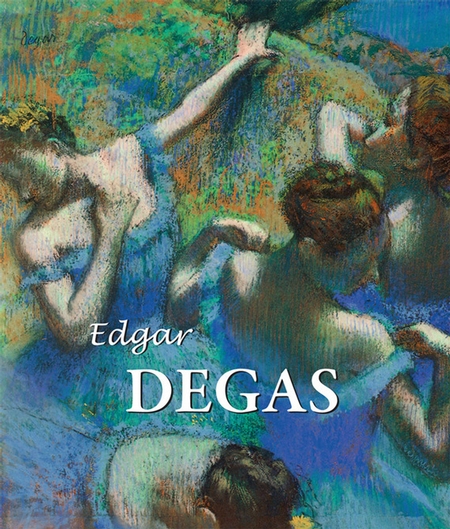
Degas was closest to Renoir in the impressionist’s circle, for both favoured the animated Parisian life of their day as a motif in their paintings. Degas did not attend Gleyre’s studio; most likely he first met the future impressionists at the Caf Guerbois. He started his apprenticeship in 1853 at the studio of Louis-Ernest Barrias and, beginning in 1854, studied under Louis Lamothe, who revered Ingres above all others, and transmitted his adoration for this master to Edgar Degas. Starting in...
Degas was closest to Renoir in the impressionist’s circle, for both favoured the animated Parisian life of their day as a motif in their paintings. Degas did not attend Gleyre’s studio; most likely he first met the future impressionists at the Caf Guerbois. He started his apprenticeship in 1853 at the studio of Louis-Ernest Barrias and, beginning in 1854, studied under Louis Lamothe, who revered Ingres above all others, and transmitted his adoration for this master to Edgar Degas. Starting in 1854 Degas travelled frequently to Italy: first to Naples, where he made the acquaintance of his numerous cousins, and then to Rome and Florence, where he copied tirelessly from the Old Masters. His drawings and sketches already revealed very clear preferences: Raphael, Leonardo da Vinci, Michelangelo, and Mantegna, but also Benozzo Gozzoli, Ghirlandaio, Titian, Fra Angelico, Uccello, and Botticelli. During the 1860s and 1870s he became a painter of racecourses, horses and jockeys. His fabulous painter’s memory retained the particularities of movement of horses wherever he saw them. After his first rather complex compositions depicting racecourses, Degas learned the art of translating the nobility and elegance of horses, their nervous movements, and the formal beauty of their musculature. Around the middle of the 1860s Degas made yet another discovery. In 1866 he painted his first composition with ballet as a subject, Mademoiselle Fiocre dans le ballet de la Source (Mademoiselle Fiocre in the Ballet ‘The Spring’) (New York, Brooklyn Museum). Degas had always been a devotee of the theatre, but from now on it would become more and more the focus of his art. Degas’ first painting devoted solely to the ballet was Le Foyer de la danse l’Opra de la rue Le Peletier (The Dancing Anteroom at the Opera on Rue Le Peletier) (Paris, Muse d’Orsay). In a carefully constructed composition, with groups of figures balancing one another to the left and the right, each ballet dancer is involved in her own activity, each one is moving in a separate manner from the others. Extended observation and an immense number of sketches were essential to executing such a task. This is why Degas moved from the theatre on to the rehearsal halls, where the dancers practised and took their lessons. This was how Degas arrived at the second sphere of that immediate, everyday life that was to interest him. The ballet would remain his passion until the end of his days.
Новый роман Дины Рубиной отправит читателя в путешествие по советской Астрахани, Польше и военной Бухаре. «Мальчики» — интригующая завязка большой авантюрной истории «Дизайнер Жорка». В доме десятилетнего Ицика на разные голоса отсчитывают время 387 часов. Уникальную коллекцию начал собирать дед мальчика, а затем продолжил отец — оба искусные часовщики. Убегая от гитлеровского нашествия, семья...
Алексей Варламов — прозаик, филолог, автор романов "Душа моя Павел" и "Мысленный волк", а также биографий русских писателей ХХ века. Лауреат премий "Антибукер", "Большая книга", "Студенческий Букер" и литературной премии Александра Солженицына. Герой нового романа Алексея Варламова "Одсун" в конце 2010-х годов приезжает в Чехию читать лекции по литературе, но вместо университета оказывается в старом доме в...
Психологический роман о скрытой силе, что есть внутри каждого и с которой не так просто справиться, когда ее вдруг осознаешь Новый роман автора, пробующего себя в новом жанре — драме о молодых взрослых. Но будет так же кинематографично, как в «Холодных глазах», иронично, как в «Большой Суете», и о семейных ценностях, как в «Типа я» Автор — лауреат литературной премии «Лицей», финалист премии...
Издательство:
Альпина Паблишер
Дата выхода: ноябрь 2025
Книга представляет собой увлекательное путешествие по языковому разнообразию мира, из которого можно узнать, как именно язык отражает и формирует человеческое мышление. Опираясь на новейшие лингвистические исследования, автор показывает различия, с которыми языки кодируют базовые понятия, такие как время, пространство, цвет, запах. Изучение редких языков дает возможность по-новому подходить...
Издательство:
Альпина Паблишер
Дата выхода: апрель 2025
Перед человечеством всегда стояла и по-прежнему стоит одна из самых сложных и тревожных проблем – вопрос о собственном будущем. С тех пор как человек осознал себя частью Вселенной, наука, философия и религия неизменно обращались к теме судьбы человеческого рода, его происхождения, эволюции и выживания. Настоящая книга – попытка взглянуть на эту проблему в контексте как современной научной картины...
Продолжение самого успешного романа о путешествии в наше советское прошлое. Сотни восторженных отзывов от читателей на "Литрес". Аудитор XXI века оказывается в теле советского школьника в 1971 году. Вместо привычных офисных будней — ночные засады на чердаке, охота за таинственным злоумышленником, спасение собак, тайники с иконами и мебель, сделанная своими руками из поддонов. Вместо смартфона — будильник,...
Оставить комментарий