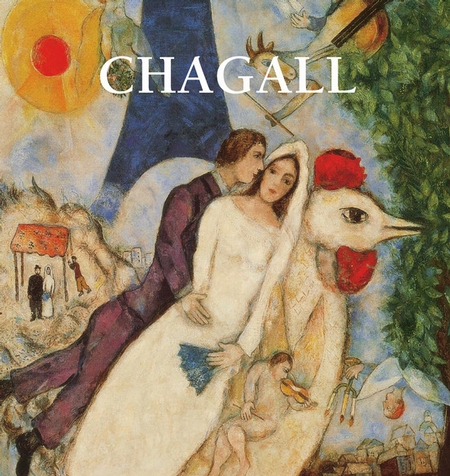
Marc Chagall was born into a strict Jewish family for whom the ban on representations of the human figure had the weight of dogma. A failure in the entrance examination for the Stieglitz School did not stop Chagall from later joining that famous school founded by the Imperial Society for the Encouragement of the Arts and directed by Nicholas Roerich. Chagall moved to Paris in 1910. The city was his “second Vitebsk”. At first, isolated in the little room on the Impasse du Maine at La Ruche,...
Marc Chagall was born into a strict Jewish family for whom the ban on representations of the human figure had the weight of dogma. A failure in the entrance examination for the Stieglitz School did not stop Chagall from later joining that famous school founded by the Imperial Society for the Encouragement of the Arts and directed by Nicholas Roerich. Chagall moved to Paris in 1910. The city was his “second Vitebsk”. At first, isolated in the little room on the Impasse du Maine at La Ruche, Chagall soon found numerous compatriots also attracted by the prestige of Paris: Lipchitz, Zadkine, Archipenko and Soutine, all of whom were to maintain the “smell” of his native land. From his very arrival Chagall wanted to “discover everything”. And to his dazzled eyes painting did indeed reveal itself. Even the most attentive and partial observer is at times unable to distinguish the “Parisian”, Chagall from the “Vitebskian”. The artist was not full of contradictions, nor was he a split personality, but he always remained different; he looked around and within himself and at the surrounding world, and he used his present thoughts and recollections. He had an utterly poetical mode of thought that enabled him to pursue such a complex course. Chagall was endowed with a sort of stylistic immunity: he enriched himself without destroying anything of his own inner structure. Admiring the works of others he studied them ingenuously, ridding himself of his youthful awkwardness, yet never losing his authenticity for a moment. At times Chagall seemed to look at the world through magic crystal – overloaded with artistic experimentation – of the Ecole de Paris. In such cases he would embark on a subtle and serious play with the various discoveries of the turn of the century and turned his prophetic gaze like that of a biblical youth, to look at himself ironically and thoughtfully in the mirror. Naturally, it totally and uneclectically reflected the painterly discoveries of Czanne, the delicate inspiration of Modigliani, and the complex surface rhythms recalling the experiments of the early Cubists (See-Portrait at the Easel, 1914). Despite the analyses which nowadays illuminate the painter’s Judaeo-Russian sources, inherited or borrowed but always sublime, and his formal relationships, there is always some share of mystery in Chagall’s art. The mystery perhaps lies in the very nature of his art, in which he uses his experiences and memories. Painting truly is life, and perhaps life is painting.
● К столетию Аркадия Стругацкого. ● Литературная энциклопедия, посвященная «Пикнику на обочине» — самому популярному роману братьев. ● Издание снабжено картами и иллюстрациями. ● В книгу вложена карта миров и героев братьев Стругацких. ● В данное издание вошли также материалы из дневников и ответы Бориса Натановича Стругацкого на вопросы читателей из «OFF-LINE интервью». Эта...
Для советских людей обвал социалистической системы стал одновременно абсолютной неожиданностью и чем-то вполне закономерным. Это драматическое событие обнажило необычный парадокс: несмотря на то, что большинство людей воспринимало советскую систему как вечную и неизменную, они в принципе были всегда готовы к ее распаду. В книге профессора Калифорнийского университета в Беркли Алексея Юрчака система...
Издательство:
Новое литературное обозрение
Дата выхода: апрель 2025
Может ли искусство спасать? Зачем оно в условиях неизбежной катастрофы? Венская художница Фридл Дикер-Брандейс (1898–1944), попав в 1942 году в Терезинское гетто, занималась рисованием с депортированными туда детьми, обреченными на смерть. Ведь из Терезина нацисты отправляли заключенных в Освенцим. Большинство маленьких учеников Фридл погибли в Холокосте. Но вместе с ней они рисовали жизнь, обретая в...
Антон и Женя живут по соседству в тихом провинциальном городке и с детства обожают всевозможные розыгрыши. Волей случая друзья становятся обладателями невероятного прибора — пульта по управлению временем. Мир теперь можно поставить на паузу, а потом запустить снова! Но почему-то только что тебе было четырнадцать, а сейчас — все двадцать пять, мама тебя не узнает и где-то рядом рыщут жуткие существа,...
Издательство:
Альпина Паблишер
Дата выхода: ноябрь 2025
Сборник живых, эмоциональных рассказов о том, как оставаться собой в мире, где всё постоянно меняется. Героиня книги — тонко чувствующий, рефлексирующий человек, который сталкивается с абсурдом, непониманием и магией повседневности. Книга для любителей современной русской прозы, ценителей короткой формы и всех, кто когда-либо чувствовал себя чужим — в другом городе, в другой стране или...
Британский историк-медиевист Энтони Бейл приглашает читателей в одиссею по миру Средневековья, полному чудес и неожиданностей, и пересказывает советы, которые передавались из уст в уста странниками того времени. Путешествуя вместе с учеными, шпионами, монахами в разные концы света, вы пройдете по улицам Рима, побываете при ханском дворе в Пекине, проедете верхом на осле по находящемуся под...
Издательство:
Альпина Паблишер
Дата выхода: март 2025
Оставить комментарий